- Reading
- 047 318
- Where
- Passenger side, behind the owner's manual
- Note
- Write it down while the day is still warm
The Glovebox Notebook
The most valuable thing in a used car is sometimes not attached to the engine at all. It is a cheap pad of paper with a pencil clipped to the spiral.
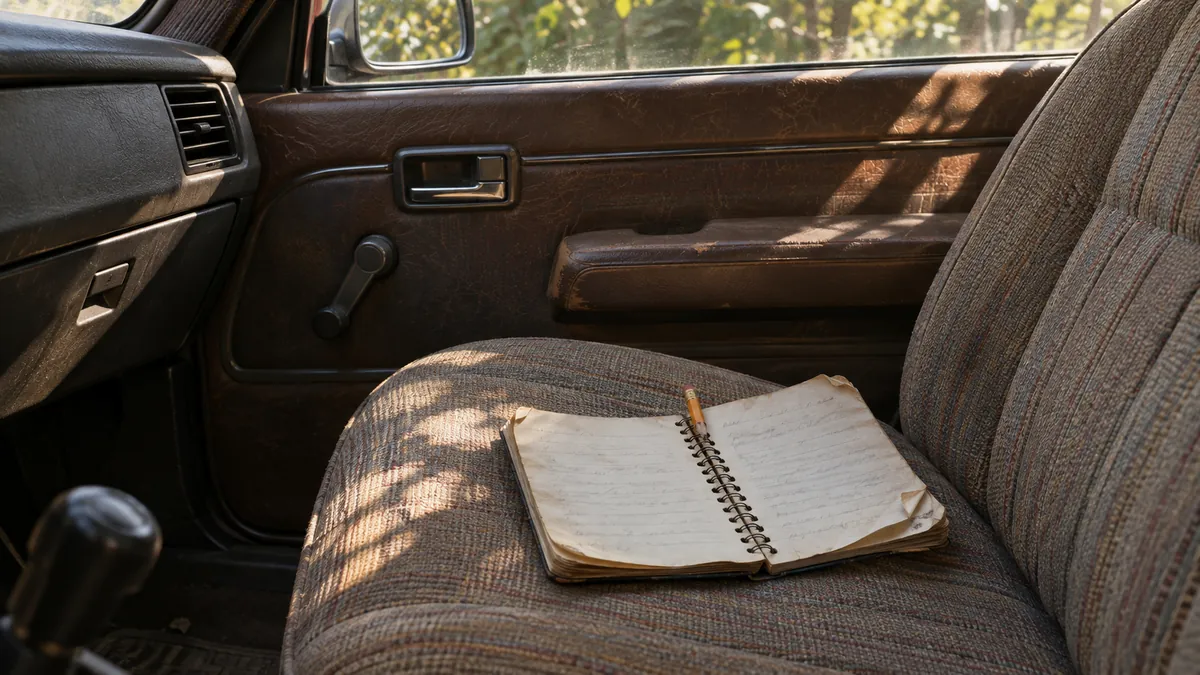
What came in with the wagon
The station wagon arrived on consignment from a retired couple who were moving closer to their daughter. When we cleaned it out, the glovebox held the manual, two pens that no longer worked and a notebook roughly the size of a hand. Inside, in at least two different handwritings, were eleven years of short lines. A date, a number from the dashboard, a few words. Tires rotated. Wiper blades, the cheap ones, a mistake. Left rear window sticks in the cold, Mr. Dutra fixed it, tip him next time.
None of the lines was longer than a sentence. Together they told us more about that car than any inspection could, because they recorded things a mechanic cannot see: what was done, when, by whom, and what the owner thought about it afterward. The buyer who took the wagon home asked to keep the notebook. That is the request we hear most often about these pads, and it says something about how people value a written record once they hold one.
Why a line on paper does more than a thought
Most of us carry a running list in our heads and trust it more than it deserves. Past fifty, plenty of people notice that the list gets crowded. You remember that you called the insurance company, but not whether it was Tuesday or Thursday. You know you changed the furnace filter recently, but recently has become a stretchy word. That is ordinary. A busy mind is not a broken one; it is simply holding more than it was built to hold without help.
Writing a short line does two useful things. First, it moves the fact somewhere outside your head, where it waits patiently and does not need rehearsing. Second, the small act of choosing the words and putting the date beside them seems to give the moment a firmer edge. People who keep a log of any kind, for a garden, a workshop or a car, often say that they remember the logged events better even on days when they never reopen the page. Researchers who study attention have paid attention to this too: the moment of writing asks the mind to sort, to decide what mattered, and that sorting is part of how a day becomes something you can find again.
How the owners of that wagon did it
Their system was almost too modest to call a system, which is why it lasted eleven years. A few features are worth copying:
The notebook lived in one place. Not in a drawer at home, not in a coat pocket. Glovebox, passenger side, behind the manual. Anything that has to be hunted for stops being used within a month.
Each line began with the date and a number. On a car the number is the mileage. In a kitchen drawer it could be the day of the week, or simply a tick mark. The fixed opening made every line easy to scan and easy to start.
They wrote short and they wrote soon. Most entries were made in the parking lot right after the errand, before the engine was even started again. Waiting until evening is when the details slide.
They let the pad be messy. Crossed out words, a coffee ring, a phone number upside down in the margin. A record you are afraid to spoil is a record you will not keep.
Bringing the habit indoors
You do not need a car to borrow this. Keep a small pad where your day naturally pauses: beside the coffee maker, on the hall table where the keys land, next to the chair you read in. Each evening, or right after anything worth remembering, write one dated line. Called the pharmacy about the refill. Walked to the river with Dan. Paid the water bill, online, confirmation in email. On Sunday, flip back through the week. It takes two minutes and it often turns up something you were about to do twice, or forget once.
The couple with the wagon never called it a memory practice. They called it the car book. Name yours whatever you like, as long as it stays in one spot and the pencil stays sharp.
Stapled to the back of this entry
A notebook is a tool for staying organized, not a check on your health. If you have been noticing changes in how you recall names, appointments or recent conversations, and those changes worry you or the people close to you, bring it up with your doctor, who can weigh the whole picture.
The same goes before you change any routine because of something you read here.